Caliber Guide
Best airgun caliber for small game: .22 vs .25, answered with real numbers
By Golden Guns Outdoors · Published · Updated · Editorial policy
On this page
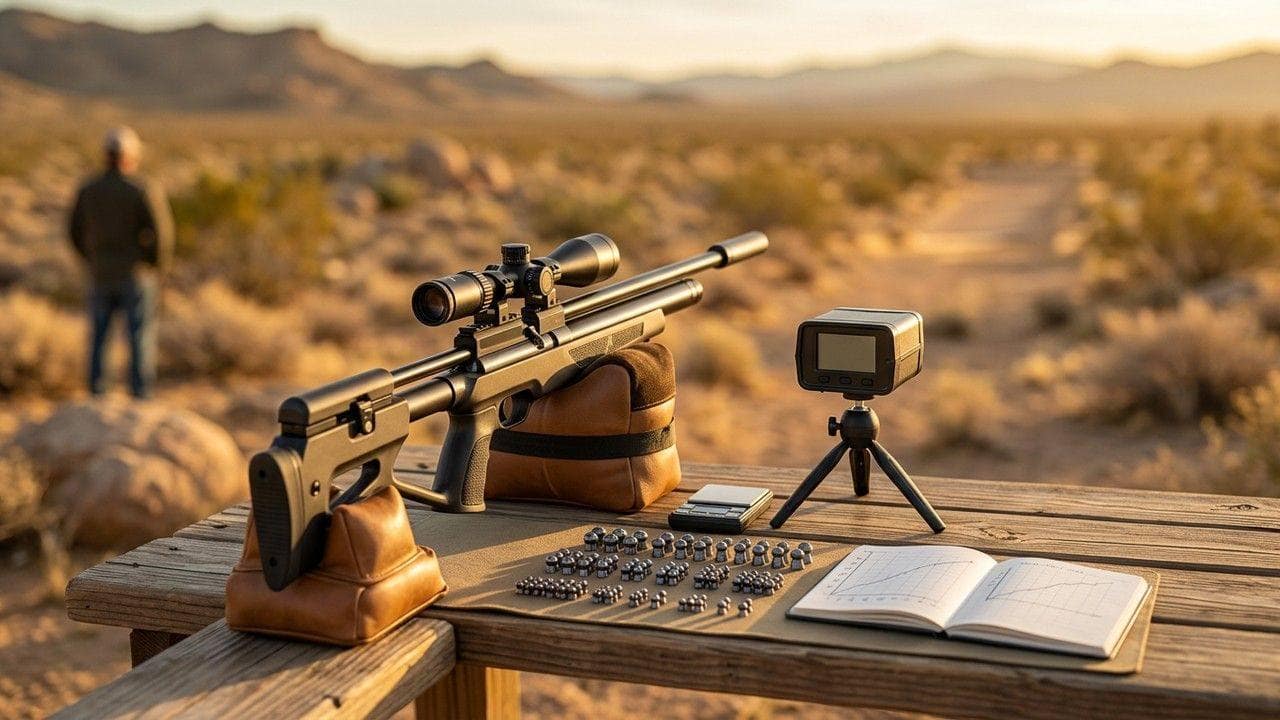
Field protocol: every load gets a 10-shot chronograph string (average velocity, extreme spread, energy) before it's trusted on game. Holdovers are confirmed at real distances, then re-confirmed in field conditions. Shots are recorded through the scope cam, and claims on this page link to footage where it exists. Full methodology & editorial policy →
The energy math (this is the whole argument)
Caliber debates get religious. Energy numbers don't. Foot-pounds of energy is weight × velocity² ÷ 450,436, and here's what common hunting loads actually produce at the muzzle:
| Caliber & load | Weight | Velocity | Muzzle energy |
|---|---|---|---|
| .177 — 8.44gr domed | 8.44gr | 900 FPS | ≈15 FPE |
| .22 — 18.1gr heavy domed | 18.1gr | 880 FPS | ≈31 FPE |
| .25 — 33.95gr heavy domed | 33.95gr | 880 FPS | ≈58 FPE |
| .22 slug — 40.1gr ACE FRAG (my hunting load) | 40.1gr | ≈950 FPS in my tuned M4 | ≈80 FPE |
Two honest conclusions from that table. First: a .22 at normal PCP power already carries roughly triple the energy a rabbit or squirrel needs at typical airgun ranges. More caliber isn't buying you a cleaner kill; shot placement is. Second: the .25's extra energy is real, but you pay for it with a loopier trajectory at equal power, roughly double the pellet cost, and a rifle that must be genuinely powerful to push those weights. That's why .25 belongs on high-power PCPs or it belongs on the shelf. The full quarry-by-quarry numbers are in the airgun FPE chart.
Don't trust the box velocity either. Advertised numbers come from featherweight alloy pellets nobody hunts with. Chronograph your actual hunting load. It's the difference between knowing your energy and guessing it.
Is .22 or .25 better for rabbits specifically?
.22, for almost everyone. Rabbits are thin-skinned with light bone; they do not require .25 energy to be taken cleanly. What kills rabbits reliably is hitting a golf-ball-sized brain zone at unknown ranges, and that's a trajectory problem, which the faster, flatter .22 makes easier. A .25 body shot also wrecks meat you presumably wanted.
Pick .25 for rabbits only when your rifle is a high-power PCP that keeps .25 pellets fast, you're stretching past 50 yards, or you hunt in wind where the heavier pellet's drift resistance genuinely matters. Those are real advantages; they're just advantages most rabbit hunters never use.
Slugs vs pellets — from someone who hunts with slugs
My Impact M4 shoots 40.1gr ACE FRAG slugs on hunts, so understand I'm arguing against my own setup here: most small-game hunters should shoot diabolo pellets.
Pellets win when
- Shots are inside ~50 yards (nearly all small game)
- You hunt backyards or semi-suburban ground. Pellets shed velocity fast, so misses are safer.
- Your rifle is a springer, gas-ram, or standard PCP. Almost every barrel shoots pellets well.
- You care about cost per shot
Slugs win when
- You're shooting 50–100+ yards. Higher ballistic coefficient keeps energy and fights wind.
- Your PCP has the power and a slug-friendly barrel, and you've proven the combo groups
- You accept more penetration and ricochet risk and choose ground accordingly
The rule I actually follow: accuracy beats projectile fashion. If your rifle groups pellets better, hunt with pellets. A perfectly placed pellet beats a slightly-off slug every single time. My slug load only earned its place after my rifle was tuned for it (the exact setup).
My 40.1gr slug load on a hunt, through the Zulus 4K.
Beginner: pellet gun or PCP?
Short version (the full breakdown is in Pellet Gun vs PCP): under about $300, buy a quality gas-ram break-barrel in .22 and learn to shoot it. With $500+ available, start with an entry-level PCP and a hand pump; near-zero recoil makes a beginner accurate in an afternoon instead of a season. The break-barrel path is cheaper, the PCP path is easier. Pick which problem you'd rather have.
Quietest backyard pest setup
Three noise sources, three fixes: (1) sonic crack: keep pellets subsonic, under ~950 FPS, with heavy projectiles; (2) muzzle blast: a fully shrouded barrel or a quality airgun moderator where legal; (3) mechanical noise: PCPs have essentially none, while springers slap a steel piston next to your ear. Put together, a moderated, shrouded .22 PCP shooting heavy pellets subsonic is very quiet. And check your city's discharge ordinance before any of this matters. The guide to backyard pest control covers legality and safe backstops.
Bottom line
One rifle for most people: a .22 PCP shooting quality domed pellets. Simplest budget path: a .22 gas-ram break-barrel. Max authority at range: .25 on a high-power PCP, accepting cost and rainbow trajectory. Quiet backyard work: shrouded .22 PCP, heavy subsonic pellets, safe backstop. Then stop shopping and go practice. Placement kills; calibers don't.
Caliber and energy toolkit
- Air rifle FPE for hunting: the complete guide, from measuring FPE to energy at the target.
- Airgun FPE chart: how much energy each quarry needs.
- Airgun FPE calculator: your own pellet weight and chronographed speed.
- .22 vs .25 for rabbit hunting: energy, wind, shot count and cost.
Gear that matches this guide
As an Amazon Associate, Golden Guns Outdoors earns from qualifying purchases. Some links may earn a commission at no cost to you. Prices and availability change. Retailer never decides the recommendation.
FAQ
What is the best airgun caliber for small game?
.22 is the best all-around choice for rabbits, squirrels, and backyard pests. It delivers clean-kill energy with a flatter trajectory and cheaper ammo than .25. Step up to .25 only on a high-power PCP for longer or windier shots.
Is .22 or .25 better for hunting rabbits?
.22 for almost everyone. Rabbits don't need .25 energy; they need a hit in a golf-ball-sized brain zone, and the flatter .22 makes that easier. Choose .25 only for a high-power PCP, shots past 50 yards, or regular wind.
Are slugs better than pellets for airgun hunting?
Past about 50 yards on a PCP with the power and barrel to stabilize them, slugs usually win on wind resistance and retained energy. Inside 50 yards, a pellet your barrel groups well is just as effective, cheaper, and safer near houses.
Should a beginner buy a pellet gun or a PCP?
Under about $300, a quality .22 gas-ram break-barrel. With $500+ for the rifle and air, an entry-level PCP with a hand pump, because near-zero recoil makes beginners accurate fast.
What is the quietest airgun setup for backyard pest control?
A shrouded or moderated .22 PCP shooting heavy pellets below about 950 fps, so there's no sonic crack, over a safe backstop. Check your city's discharge ordinance first.