Beginner Guide
Pellet gun vs PCP: which should you buy first?
By Golden Guns Outdoors · Published · Updated · Editorial policy
On this page
Field protocol: every load gets a 10-shot chronograph string (average velocity, extreme spread, energy) before it's trusted on game. Holdovers are confirmed at real distances, then re-confirmed in field conditions. Shots are recorded through the scope cam, and claims on this page link to footage where it exists. Full methodology & editorial policy →
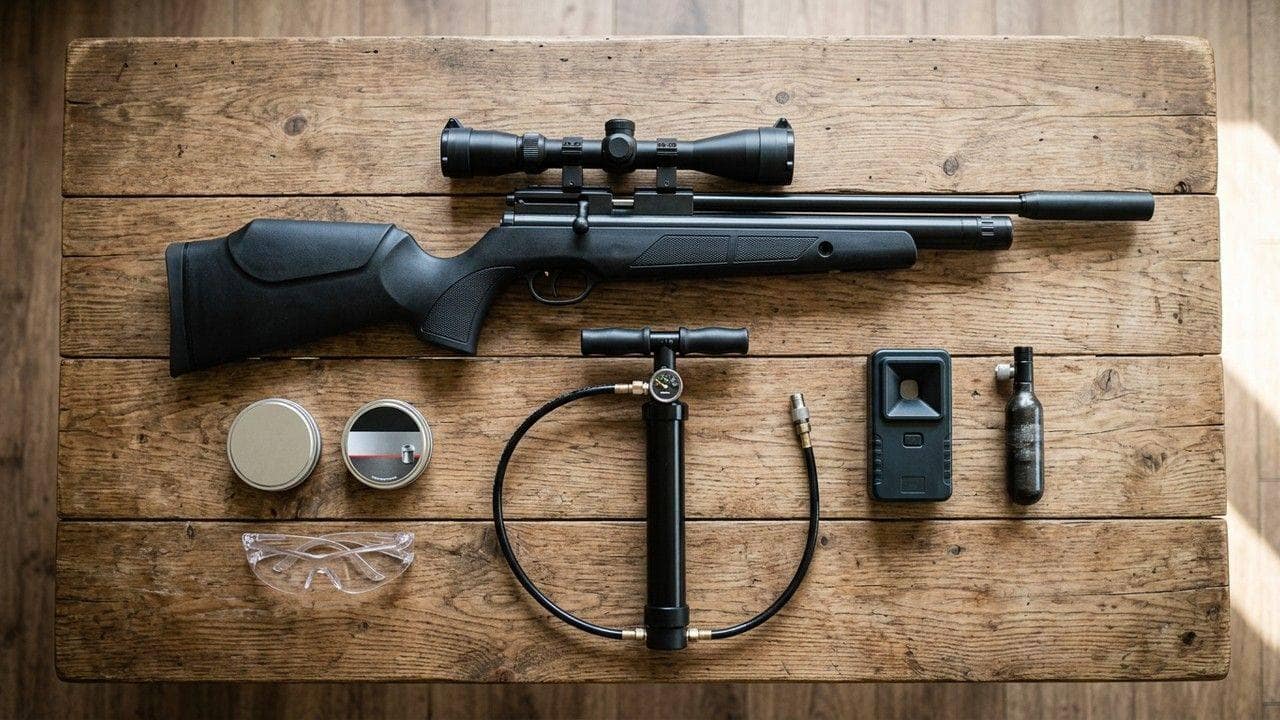
Terminology first, because it trips everyone: PCPs shoot pellets too. When people say "pellet gun" they usually mean a break-barrel (spring-piston or gas-ram) you cock for each shot. A PCP, a pre-charged pneumatic, shoots from an onboard reservoir filled to 3,000+ PSI. Same projectiles, completely different ownership experience.
The real cost of each path
| Cost item | Break-barrel path | PCP path |
|---|---|---|
| Rifle | $150–300 gets genuine quality | $190–450 for an entry PCP (six compared) |
| Air support | None, fully self-contained | Hand pump ~$100–250, or tank/compressor $400–800 (compare) |
| Scope reality | Needs a springer-rated scope; recoil kills cheap glass | Any decent scope survives; no recoil |
| Hidden cost | Your time: mastering the artillery hold | Your money: the fill ecosystem |
| Realistic day-one total | ~$200–350 | ~$400–700 |
The artillery-hold problem nobody warns beginners about
Spring-piston rifles recoil backward and forward before the pellet exits. Grip one tight, rest it on sandbags like a firearm, and it sprays. The fix is the "artillery hold": balance the forend on an open palm, use a feather-light grip, and let it jump the same way every shot. It's learnable, and shooters who learn it become better shots than PCP-only people. But if you want accuracy this afternoon instead of this month, that's precisely what PCP money buys: near-zero recoil and no hold sensitivity.
I've watched it happen. My fiancée had never held a gun, and with a PCP she was hitting apples the same afternoon:
A first-time shooter with a PCP. No recoil to fight, so the basics click fast.
How I ran that session is in how to teach someone to shoot an air rifle.
What each platform actually hunts well
A .22 gas-ram at typical power kills rabbits, squirrels, and pests cleanly inside ~35 yards, the range where most small-game shots happen anyway. A .22 PCP does the same with less noise (shrouded barrels), faster follow-ups (magazines), and easier precision at unknown ranges. Neither platform excuses skipping the energy math: check your load in the FPE calculator and read the caliber guide for the 9–12 FPE-at-the-animal floor.
The verdict by budget
Under $300: gas-ram .22 break-barrel + a tin of JSB domes + range time. You'll hunt this month and you'll learn to shoot. $500+ all-in: entry .22 PCP + hand pump, the easiest accurate start in airgunning; step by step in the first-PCP buyer's guide. The mistake: a $150 PCP-shaped bargain or a big-box springer with a scope that dies in 200 shots. Buy once.
Solid first-rifle picks
As an Amazon Associate, Golden Guns Outdoors earns from qualifying purchases. Some links may earn a commission at no cost to you. Prices and availability change. Retailer never decides the recommendation.
FAQ
What's the difference between a pellet gun and a PCP?
Both shoot pellets. "Pellet gun" usually means a break-barrel spring-piston or gas-ram rifle you cock for each shot. A PCP (pre-charged pneumatic) shoots from an onboard air reservoir filled to 3,000+ psi, so it has almost no recoil but needs a pump, tank, or compressor.
Are PCP air rifles worth the extra cost?
For most hunters, yes. Near-zero recoil makes them far easier to shoot accurately, they're quieter with a shroud, and magazines give fast follow-ups. The catch is the air system, which adds $100–$800 depending on how you fill.
Why is my break-barrel air rifle inaccurate?
Usually the hold. Spring guns recoil back and forward before the pellet leaves the barrel, so gripping tight or resting it hard like a firearm scatters shots. Use the artillery hold: forend balanced on an open palm, light grip, same hold every shot.
Is a PCP good for a first-time shooter?
Yes. With no recoil to fight, beginners can focus on the basics. My fiancée hit apples on her first afternoon ever shooting, using a PCP.