Buyer's Guide · PCP
Your first PCP: the complete day-one buyer's guide
By Golden Guns Outdoors · Published · Updated · Editorial policy
On this page
Field protocol: every load gets a 10-shot chronograph string (average velocity, extreme spread, energy) before it's trusted on game. Holdovers are confirmed at real distances, then re-confirmed in field conditions. Shots are recorded through the scope cam, and claims on this page link to footage where it exists. Full methodology & editorial policy →
1. The rifle: .22, proven, boring on purpose
Your first PCP should be a known-quantity platform with parts, community answers, and consistent shot strings. Marauder-, Gauntlet-, and Avenger-class rifles exist in huge numbers because they deliver. A regulator (Gauntlet 2, Avenger) keeps every shot at the same pressure. An unregulated rifle like the Marauder is consistent inside its sweet spot of the fill. Caliber: .22. The caliber guide covers why it beats .177 and .25 for a first hunting rifle. Six popular first PCPs are compared side by side, with my top pick, in best air rifles for rabbit hunting. Skip flagship money for now. My Impact M4 review explains why that tier is a second-rifle decision.
2. Air: the hand pump vs compressor decision
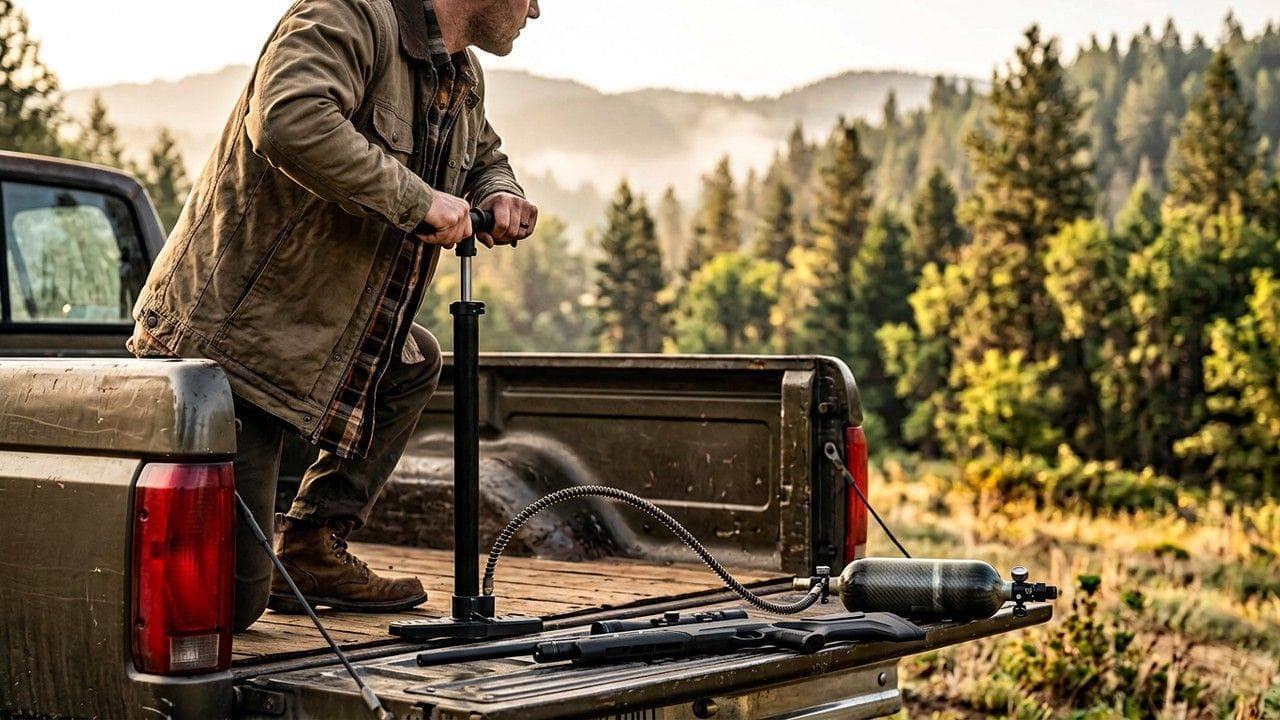
This is the cost the price tag hides. PCPs run on 3,000+ PSI air that has to come from somewhere.
- Hand pump (~$100–250): the right first answer for rifles that fill to 3,000–3,625 psi. Topping up an entry PCP is a few minutes of honest cardio. You'll know within two months whether your shot volume justifies more.
- Portable compressor (~$400–800): push-button convenience, worth it once you're shooting a lot or own a 4,500 psi rifle.
- Carbon fiber tank (~$570 for 74 cu ft): fast, silent fills. It needs a dive or paintball shop for refills and has service-life and re-test requirements.
Full comparison with fill times and fills per tank: how to fill a PCP.
3. Pellets: buy three tins, not one
Every barrel has preferences. Start with the standard, JSB Exact Jumbo-class domes, plus a heavy dome like H&N Baracuda. Shoot honest groups at 25 and 40 yards and let paper pick your hunting load. Do not hunt with pointed "power" pellets, whatever the box art says.
4. The chronograph: the first upgrade that matters
Advertised velocities are lightweight-alloy fantasies. Your hunting pellet's real speed sets your energy, your holdovers, and whether you're above the humane floor. Run the math in the FPE calculator, then verify it. A radar unit like the Garmin Xero reads every shot from the bench with no downrange setup.
How do you set up a new PCP air rifle, step by step?
Set up a new PCP in seven steps: read the manual for your rifle's maximum fill pressure, inspect and fill to that rating, mount and level the scope, zero at your hunting distance, chronograph a string, test two or three pellets for groups, and log your fill range. The safety points come from the rifle makers' own manuals (Crosman's Benjamin Marauder, Umarex's Gauntlet and FX's Impact M4), and the number in your manual is the limit that counts.
- Read the manual for the maximum fill pressure. The number is specific to your rifle. Crosman's Marauder manual says "DO NOT fill the airgun to more than 3000 psi," and Umarex's manual for the original Gauntlet gives a 3,000 psi (207 bar) maximum (the Gauntlet 2 is rated to 4,500 psi). FX's Impact M4 manual lists 250 bar for a single-regulator setup (300 bar for dual) and points to the markings on the air reservoir. Your pump, tank or compressor rating never raises the rifle's limit.
- Inspect the rifle, then fill to the rated pressure. Put on shooting glasses first: Crosman's manual says you and others with you should always wear them, and FX recommends eye protection. Check that the fill fitting is clean and its seal is in place. Fill slowly, since Umarex warns that filling too fast builds heat and gives an inaccurate gauge reading, and stop at the rating. Bleed the fill hose before you pull it off, because Crosman and Umarex both warn that an unbled hose can whip. FX also says to use dry air only, never oxygen or any other gas. The full routine is in how to fill a PCP air rifle.
- Mount and level the scope. FX's manual says to mount optics according to the optics manual and to hold off zeroing until you have worked through the rifle manual. The Marauder and Gauntlet manuals linked below say nothing about mounting optics, so the scope maker's instructions rule. Athlon's mounting guide levels the scope with a spirit level across the turret caps, sets eye relief with the rifle shouldered, and tightens ring screws in a crisscross pattern to the manufacturer's torque spec. Details: how to mount and level a scope.
- Zero at your hunting distance. Shoot from a rest with a safe backstop behind the target. Air Arms' beginner guide starts at 10 yards whatever the final zero will be, fires three-shot groups to make adjustments, then moves the target to the chosen zero distance and confirms with a five-shot group. Pick that final distance from the shots you will actually take. How to zero an air rifle scope explains how.
- Chronograph a string. Shoot a string of about 10 shots over your chronograph and write down average velocity, extreme spread (fastest minus slowest) and muzzle energy. Compare the average with the advertised number, then run the energy through the FPE calculator. Options are compared in best airgun chronographs.
- Test two or three pellets for groups. Crosman says airguns are individualistic and there is no reasonable way to predict which pellet a barrel will like. It suggests five-shot groups from a rest at a minimum of ten yards, then ten-shot groups or longer ranges to separate the finalists. Choose by paper, not by the box, and re-check your zero with the pellet you pick. See how to find the most accurate pellet.
- Log your fill range. Record the starting fill pressure with every string, plus date, pellet, average velocity, extreme spread and temperature. Air Arms' chronograph guide lists fill pressure among the conditions to note for PCPs. After a few strings you can see the fill range where velocity holds steady and the pressure where it starts to fall, which tells you when to top up. The Marauder manual's "between 2000 psi and 3000 psi" window, which depends on your tune, shows why that range differs from rifle to rifle.
Mistakes that wreck first setups
- Spending the whole budget on the rifle and having no air source. The rifle is a club without it. Beginner PCPs under $500 are priced with the pump included.
- The $150 mystery PCP. Leaking valves and no parts support cost more than the savings. What leaks and bad valves look like →
- Skipping the backstop. A proper pellet trap makes practice safe and legal in more places, and practice is the whole game.
- Tuning before shooting. Entry rifles come set up sanely. Learn the rifle stock; touch screws later, if ever.
The complete first-PCP kit
As an Amazon Associate, Golden Guns Outdoors earns from qualifying purchases. Some links may earn a commission at no cost to you. Prices and availability change. Retailer never decides the recommendation.
FAQ
What do I need to buy with my first PCP air rifle?
Four things on day one: the rifle, an air source (a hand pump at minimum), two or three tins of quality pellets to find what your barrel likes, and a safe backstop or pellet trap. The first upgrade after that is a chronograph.
How much does a first PCP setup really cost?
About $400–700 all-in for an entry .22 PCP, a hand pump, pellets, and a pellet trap. A carbon fiber tank or portable compressor adds roughly $400–800 later.
What is the best first PCP for a beginner?
My top pick is the Benjamin Marauder in .22, because the whole system runs on a hand pump and it's very quiet. The Air Venturi Avenger is the runner-up for value and tunability if you'll also buy a tank or compressor. If the whole setup, pump included, has to stay under $500, the Hatsan Flash QE Regulated is the pick; see best beginner PCP air rifles under $500.
Should my first PCP be regulated?
A regulator keeps every shot at the same pressure, so velocity stays consistent across the fill, which is nice to have. It isn't mandatory. An unregulated rifle like the Marauder is consistent inside its sweet spot, and you learn that with a chronograph.
How do you set up a new PCP air rifle?
Follow seven steps: read the manual for the maximum fill pressure, inspect and fill to that rating, mount and level the scope, zero at your hunting distance, chronograph a 10-shot string, test two or three pellets for groups, and log your fill range. The fill limit is your rifle's own rating, such as 3,000 psi in Crosman's Benjamin Marauder manual and Umarex's original Gauntlet manual, or 250 bar for a single-regulator FX Impact M4.
What pressure should I fill a new PCP to?
Fill to the maximum in your rifle's manual and no higher. Crosman's Marauder manual says not to fill above 3,000 psi and to stop between 2,000 and 3,000 psi depending on your tune. FX lists 250 bar for a single-regulator Impact M4 (300 bar for dual) and points to the markings on the air reservoir.
Sources
- Crosman — Benjamin Marauder owner's manual (BP1763 / BP2263 / BP2563)
- Crosman — Benjamin Marauder owner's manual (BP1764 / BP2264 / BP2564)
- Umarex USA — Gauntlet owner's manual (item nos. 2252603 / 2252604)
- FX Airguns — Impact M4 owner's manual
- Athlon Outdoors — How to mount a riflescope
- Air Arms — How to zero an air rifle, beginner-friendly step by step
- Air Arms — What is an air rifle chronograph? A practical guide
- Crosman — Airgun pellets and accuracy