Optics · Buyer's Guide
Best low-light air rifle scopes for dawn and dusk
Researched by Golden Guns Outdoors · Updated · Editorial policy
On this page
This is a research guide. I haven't hunted with the glass scopes below; I film my own hunts through a DNT Zulus 4K digital day/night scope on an FX Impact M4. Scope specs and prices come from the retailer listings linked in Sources, checked in October 2026, and the optics principles come from Outdoor Life and Optics Warehouse. Arken Optics sponsors my channel, and the Arken scope here is included as a comparison, not a pick. Full methodology & editorial policy →
What makes a scope good in low light?
Three things, in this order: the size of the exit pupil, the quality of the glass and coatings, and a reticle you can still see. The exit pupil is the beam of light leaving the eyepiece, and it's simply the objective diameter divided by the magnification. In Outdoor Life, Ron Spomer gives the example of a 50mm objective at 10x making a 5mm exit pupil.
Your eye sets the limit. Spomer puts a pupil at about 2.5mm in full daylight, about 4mm on a cloudy day, about 6mm around the end of legal shooting light and about 7mm when it's nearly dark. Optics Warehouse adds that younger shooters can open to 7mm or more, while an older shooter may only reach about 5mm. An exit pupil bigger than your own pupil can't make the image brighter, but one smaller than your pupil makes it dimmer.
Glass and coatings decide how much of that light survives the trip. Spomer notes that raw glass loses about 4 percent of the light at each surface it enters and leaves, and one anti-reflection layer roughly halves that loss. There's no easy way to verify a brand's transmission claims at the counter, which is why reviews from people who use a scope at last light are worth reading.
Tube size isn't on the list. Spomer's verdict on the idea that a 30mm tube makes a scope brighter is "forget it": the wider tube mostly buys more adjustment range.
What exit pupil does each magnification give?
Use this table to set your power ring as the light goes. Aim for an exit pupil of at least 5-7mm at last light.
| Magnification | 40mm objective | 44mm objective | 50mm objective |
|---|---|---|---|
| 4x | 10.0 mm | 11.0 mm | 12.5 mm |
| 6x | 6.7 mm | 7.3 mm | 8.3 mm |
| 7x | 5.7 mm | 6.3 mm | 7.1 mm |
| 8x | 5.0 mm | 5.5 mm | 6.2 mm |
| 10x | 4.0 mm | 4.4 mm | 5.0 mm |
| 12x | 3.3 mm | 3.7 mm | 4.2 mm |
| 16x | 2.5 mm | 2.8 mm | 3.1 mm |
Spomer's advice is to turn the power down: a 50mm scope at 7x makes a 7.1mm exit pupil, matching what a dilated eye can use. For airgun small game inside 50 yards, 4-7x is plenty of magnification anyway, and it widens your field of view for finding a rabbit at the edge of the brush.
Best low-light air rifle scopes, compared
| Scope | Exit pupil (low-high power) | Illumination | Closest parallax | Tube | Weight | Price checked |
|---|---|---|---|---|---|---|
| Hawke Vantage IR 4-12x50 AO | 13-4 mm | Mil Dot, red or green, 5 levels each | 10 yd (9 m) | 1 in | 21.2 oz | $299.99 (MK Machining) |
| UTG 4-16x44 AO Accushot SWAT | 11-2.7 mm | Mil Dot, 36 colors, or red/green | 10 yd | 30 mm | 21.8 oz | $199.99 (Baker Airguns, out of stock when checked) |
| Athlon Argos BTR Gen2 6-24x50 FFP IR | 8.2-2.1 mm | Illuminated FFP reticle | 10 yd (side focus) | 30 mm | 30.3 oz | $369.99 (Baker Airguns, out of stock when checked) |
| Arken SH4 Gen2 4-16x50 FFP | 12.5-3.1 mm (calculated) | Red illuminated | 25 yd (side focus) | 34 mm | 35.6 oz | $347.99 (MK Machining) |
Specs are each retailer's listing, checked in October 2026. The Arken's exit pupil is calculated from its 4-16x50 spec because the listing doesn't give one.
Hawke Vantage IR 4-12x50 AO: the low-light pick. It has the biggest exit pupil here: the listing gives 13-4mm, which works out to about 12.5mm at 4x and still 5mm at 10x. The adjustable objective focuses from 10 yards (9 m), which matters on an airgun. The illuminated Mil Dot reticle has five brightness levels in both red and green and can be switched off. It's a 1-inch scope at 21.2 oz, so it won't make a light PCP front-heavy.
UTG 4-16x44 AO Accushot SWAT: the budget pick. $199.99 buys an 11mm exit pupil at 4x, a 10-yard parallax and 36 illumination colors in a 21.8 oz, 11.14-inch scope. The 44mm objective gives up a little light to the 50mm scopes at the same power (6.3mm vs 7.1mm at 7x). It was out of stock at Baker Airguns when checked.
Athlon Argos BTR Gen2 6-24x50 FFP IR: for holdover at distance. It's a first focal plane scope, so its holdover marks are correct at every power, and side focus goes down to 10 yards. The trade-off is that it starts at 6x, so its biggest exit pupil is 8.2mm, and it weighs 30.3 oz. Pick it if you take longer shots on ground squirrels or doves and range before you hold.
Arken SH4 Gen2 4-16x50 FFP: a firearm scope for comparison. It has big 50mm glass, a red illuminated reticle and a 34mm tube. Its side focus only comes down to 25 yards, though, so close airgun shots stay out of focus. That's the same trade-off I describe for the Arken Outrider in best air rifle scopes: fine for a hog at 60 yards, less so for a squirrel inside 25.
Do you need an illuminated reticle for low light?
You need one when a black reticle disappears against a dark target, like a squirrel in shadowed brush or a dove against a dark tree line. Keep it on the lowest setting you can see. A bright reticle blooms, and your eye adjusts to it instead of to the target. Some backgrounds show one color better than another, which is why it helps that the Vantage IR offers both red and green.
Focal plane matters here too. A second focal plane reticle stays the same size when you turn the power down at dusk, so it stays easy to see, but its holdover marks are only correct at one power. A first focal plane reticle shrinks at low power, so illumination helps it more, but its marks stay true at every power. First vs second focal plane explains which suits how you shoot.
When does glass stop working, and what comes next?
Glass only gathers light that's there. Once legal light ends, the shooting should too: for California upland game birds, including Eurasian collared doves, 14 CCR §310.5 sets shooting hours from one-half hour before sunrise to sunset. Check your state's hours for each species before you plan a dusk hunt; for dove rules in California, see California dove airgun laws.
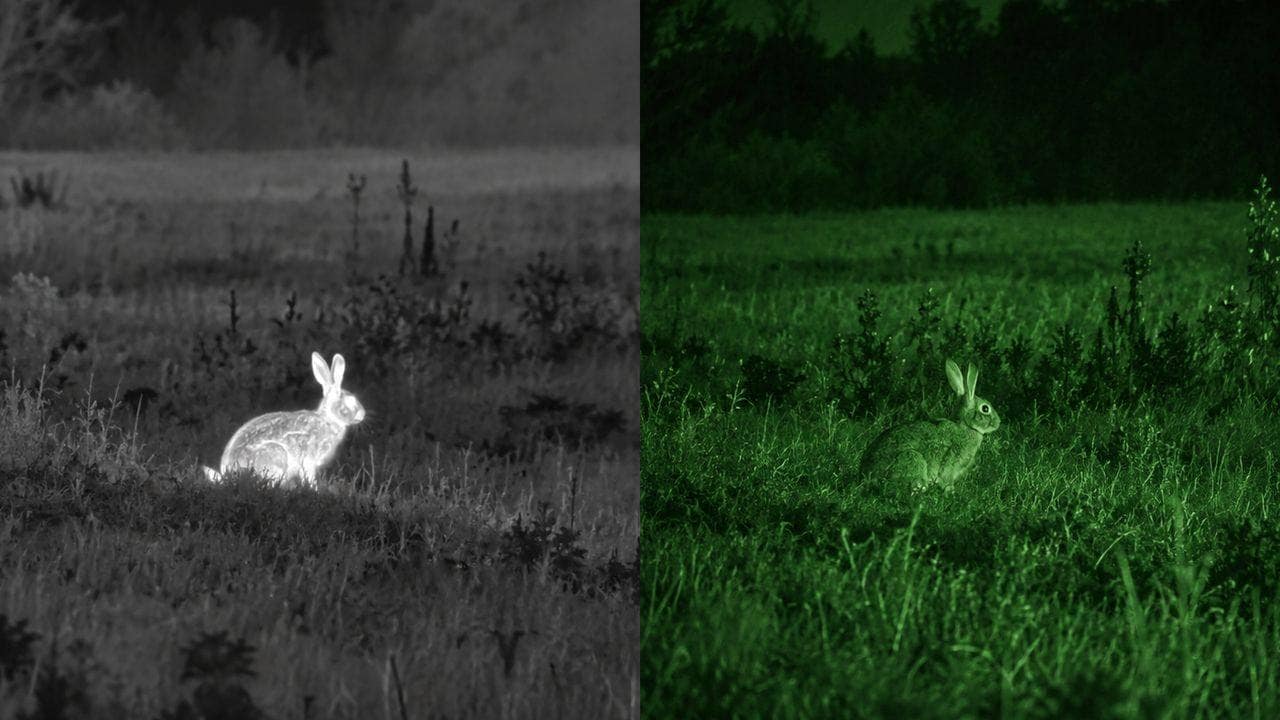
Digital day/night scopes and thermal keep working in the dark, but the law gets stricter. California Fish and Game Code §2005(c) makes it unlawful to use or possess night vision equipment to assist in taking any bird or mammal, with narrow exceptions, such as agricultural landowners and their employees on their own property. Where night hunting is legal, the options are covered in thermal vs night vision for hunting and best night vision scopes under $500.
My own digital scope, the DNT Zulus 4K, records every hunt, but it's a different tool from the glass above. Its 30fps refresh lags a little on fast targets, and it has no built-in IR illuminator, so real night work needs an external one. The full write-up is in my DNT Zulus 4K review.
How do you set up a scope for the last half hour of light?
- Zero and focus in daylight. Set your zero at your usual hunting distance (how to zero an air rifle scope) and know where parallax sits for 20, 30 and 40 yards before the light goes.
- Drop the power as the light drops. Start the evening at your normal power and come down to 4-7x for the last half hour.
- Set illumination low before you need it. Find the lowest visible setting while you can still see the reticle without it.
- Keep lenses clean and capped. Dust and fingerprints scatter what little light there is.
- Identify the target and the backstop. If you can't see what's behind the animal, don't shoot. Airgun pellets and slugs ricochet off hard ground and rocks.
Good fit
- 44-50mm objective with 10-yard parallax
- Illumination with a truly dim lowest setting
- Running 4-7x in the last half hour of legal light
Look elsewhere
- Firearm scopes whose parallax stops at 25 yards or more
- Paying extra for a 30mm tube to get brightness
- Digital night vision for taking game in California
Verdict
For dawn and dusk small game, buy the Hawke Vantage IR 4-12x50 AO: the biggest exit pupil on this list, focus down to 10 yards, and dimmable red or green illumination. Save money with the UTG 4-16x44 AO Accushot, or step up to the Athlon Argos BTR Gen2 6-24x50 FFP if you take longer shots and hold over. Whatever you buy, the best low-light setting is a lower magnification, not a more expensive scope.
Low-light scope picks
As an Amazon Associate, Golden Guns Outdoors earns from qualifying purchases. Some links may earn a commission at no cost to you. Prices and availability change. Retailer never decides the recommendation.
FAQ
What is the best low-light scope for an air rifle?
For most small-game hunters, the Hawke Vantage IR 4-12x50 AO ($299.99 when checked). Its 50mm objective gives a 12.5-13mm exit pupil at 4x, it focuses down to 10 yards, and its reticle has five brightness levels in red and green. On a tighter budget, the UTG 4-16x44 AO Accushot ($199.99) has a 10-yard parallax and 36 illumination colors.
Does a bigger objective lens make a scope brighter?
Yes, at the same magnification. The exit pupil is the objective diameter divided by the magnification, so a 50mm lens at 7x gives a 7.1mm exit pupil, while a 40mm lens at the same power gives 5.7mm. A small objective at low power can still be as bright as a big one at high power, so turn the magnification down as light fades.
Is a 30mm tube brighter than a 1-inch tube?
No. In Outdoor Life, Ron Spomer's verdict on the idea that a wider main tube adds brightness is "forget it." Tube size mostly buys more internal adjustment range. The Hawke Vantage IR on this page has a 1-inch tube and the biggest exit pupil here.
What magnification is best at dusk?
Low power. On a 50mm scope, 7x gives a 7.1mm exit pupil, about the most a fully dilated young eye can use; older eyes may only open to about 5mm, which a 50mm scope still gives at 10x. For small game inside 50 yards, 4-7x is plenty of magnification and keeps the image as bright as the scope can make it.
What exit pupil do I need for low light?
Aim for 5-7mm or more. Outdoor Life puts a dilated pupil at about 7mm near dark and about 6mm around the end of legal shooting light; Optics Warehouse notes older shooters may only reach about 5mm. Anything bigger than your own pupil adds no brightness, but it makes the image easier to find behind the scope.
Do I need an illuminated reticle for hunting at dusk?
It helps whenever the reticle disappears against a dark background, like a squirrel against shadowed brush. Use the lowest setting you can see: a bright reticle blooms and makes your eye adjust to it instead of the target. The Vantage IR has five levels in red and green; the UTG offers 36 colors.
Can I use a night vision scope for hunting in California?
Mostly no. California Fish and Game Code §2005(c) makes it unlawful to use or possess night vision equipment to assist in taking any bird or mammal, with narrow exceptions such as agricultural landowners and their employees on their own property. That's why glass scopes are the legal low-light tool for most California hunters.
Is FFP or SFP better in low light?
SFP reticles stay the same size at every power, so they stay easy to see when you turn the power down at dusk. An FFP reticle shrinks at low power, and illumination helps it. FFP holdover marks are correct at every magnification, so they suit shooters who range and hold over rather than dial. More in FFP vs SFP.
Sources
- Outdoor Life — Understanding riflescope brightness misconceptions (Ron Spomer, April 7, 2020)
- Optics Warehouse — The effect of eye pupil on rifle scope performance
- MK Machining — Hawke Vantage IR 4-12x50 AO (specs and price)
- Baker Airguns — Leapers UTG 4-16x44 AO Accushot SWAT (specs and price)
- Baker Airguns — Athlon Argos BTR Gen2 6-24x50 FFP IR (specs and price)
- Adorama — Athlon Argos BTR Gen2 6-24x50 FFP IR (exit pupil spec)
- MK Machining — Arken SH4 Gen2 4-16x50 FFP (specs and price)
- Cal. Code Regs. tit. 14, §310.5 — shooting hours for upland game birds (Cornell LII)
- California Fish and Game Code §2005 — artificial light and night vision restrictions